Frank eventually bought Pal from me, for $1000, his Fender Jazzmaster guitar and a set of drums. He renamed it "Studio Z" and I went off to Hollywood to a partnership in a bigger studio with Mr. Art Laboe, the DJ who originated the Oldies But Goodies concept.
This is a collage of some dialog and music from the party on opening night. The guests included Captain Beefheart, his former girlfriend Laurie, Ray Collins, Motorhead Sherwood, and Bob Narciso. Bob is singing about the Pall Malls. Motorhead is talking about his girlfriend.
Drumbo's book [Beefheart: Through The Eyes Of Magic, 2010] reveals that her name was Laurie Stone.
IB: What was Studio Z like?
LBC: Studio Z had blacked out storefront windows. Upon entering, there was an office to the left, control room to the right, then double swinging doors which led to the recording area, which was a huge room. To the left were dilapidated couches, to the right a grand piano. Musical instruments and drum sets, cords running everywhere. Past the piano was a long rectangular area where he projected films on the back wall. Past the couches there was a wall with a window and door that led into the bedroom, which was festooned with a myriad of wacky items, including a huge aquarium filled with decapitated dolls...heads & arms filling it to the brim. On the back wall was a glittering juke box. That was the door to the bathroom. You could open it up and had to duck to get in there.
Meanwhile, back at "STUDIO Z," I had been working on what might have been the world's first 'rock opera' . . . a stupid piece of trash called I WAS A TEEN-AGE MALT SHOP. This was the opening theme. F.Z. on piano, Motorhead on acoustic guitar, Vic Mortenson on drums.
The correct spelling is Mortensen.
[The 'Hippie Riff'] can be plainly heard in the opening section of I Was a Teenage Maltshop
In our spare time we made what we thought were 'rock & roll records.' In this example, Vliet was 'singing' in the hallway outside the studio (our vocal booth) while the band played in the other room.
The lyrics were derived from a comic book pinned to a bulletin board near the door. The musicians include F.Z. on guitar, Vic Morthenson on drums, and a bass player from a surf group (identity unknown).
If this was recorded on the same session as "Tiger Roach," according to the liner notes of The Lost Episodes, the name of the bass player is JANSCHI.
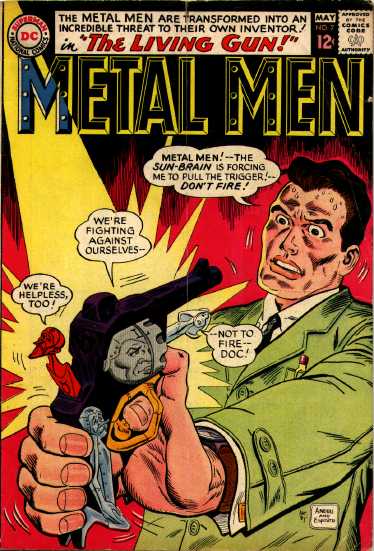
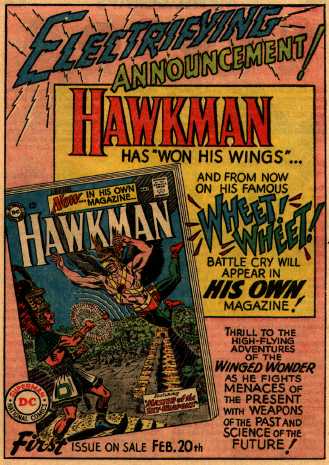
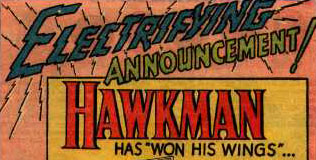
The following images are the cover and a full-page ad from the DC comic Metal Men #7, April-May 1964. This book would have been on sale in early 1964; its on-sale date was probably February 20, the same as that of the Hawkman comic advertised (which also shows a cover date of May). This is clearly the source of the lyrics of "Metal Man Has Won His Wings." (Note that, contrary to the official title, it is actually Hawkman, in both the song and the original advertisement, who has "won his wings.") This proves that "Metal Man Has Won His Wings" must actually date from February 1964 at the very earliest.
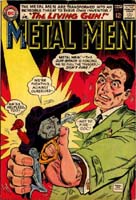
Wheet! Wheet!

Metal Men!
![]()
The Living Gun!
![]()
Hawkman,
'Lectro-flyer,
Announcement,
Has won his wings!
See also: Tiger Roach
An example of multiple overdubs and half speed recording, circa 1962. F.Z. speeded-up lead and rhythm guitar, Doug Moon, rhythm acoustic guitar.
On rhythm guitar with a white light blue triangles behind him, Elliot Bro-Ingber
ELLIOT INGBER: Alternate lead & rhythm guitar with clear white light
FZ: Agency Man is about advertising agencies selling political candidates [...]. The song was written because at a certain point in American political history, politicians discovered Madison Avenue, and it changed the face of American politics. Because the Republicans always had more money that the Democrats, they were the first to hire a real Madison Avenue agency. I believe it was BBD&O, Batten, Barton, Durston, and Osborne, (laughter) that took on the Republican campaign. I think it was for the Nixon campaign. The amount of money they started to spend on the campaign became science fiction. That was the beginning of what we have now. [...] So, that's where it came from, the idea that instead of dealing with the issues, you're just dealing with the candidate as a product "Sell us a president. Agency Man."
Site maintained by Román García Albertos